Soul Lessons From God: The Grace of Trust & Faith
.png/:/cr=t:0%25,l:14.14%25,w:72.97%25,h:100%25/rs=w:365,h:365,cg:true)
.png/:/cr=t:0%25,l:8.12%25,w:74.67%25,h:100%25/rs=w:365,h:365,cg:true)
.png/:/cr=t:0%25,l:7.8%25,w:74.67%25,h:100%25/rs=w:365,h:365,cg:true)
Trust & Faith: The Ravens of NM
Trust & Faith: The Ravens of NM
Trust & Faith: The Ravens of NM

Trust & Faith: The First Eaglet
Trust & Faith: The Ravens of NM
Trust & Faith: The Ravens of NM

Trust & Faith: Red-Tail Rising
Trust & Faith: Return to Beginning
Trust & Faith: Return to Beginning
Trust & Faith: Return to Beginning
Trust & Faith: Return to Beginning
Trust & Faith: Return to Beginning
Soul Lessons From God: Trust & Faith The Ravens & New Mexico

When the Threshold Speaks Before the Revelation Arrives
The Land That Called Me South
Some journeys begin long before you pack a bag. They begin as a quiet ache, a pull in the chest, a sense that something in you is reaching toward a place you haven’t yet touched. New Mexico has been that place for me — a landscape that feels both familiar and unknown, a horizon that keeps calling even when I don’t fully understand why.
Last weekend, I finally went.
I didn’t go for scenery or escape. I went because I needed clarity. I needed to know whether this land was meant to be part of my next chapter, whether it held something for me, whether it could be home. I didn’t know what I would find. I didn’t know what I was looking for. I only knew that I had to go.
But clarity rarely arrives in the way we expect.
And it never arrives on our timeline.
I didn’t see many animals at first. The land felt quiet, almost withholding, as if waiting to see what I would bring to it. But then — slowly, steadily, unmistakably — the ravens began to appear.
And once they started, they didn’t stop.
The Ravens — The Messengers of the Threshold
It began just south of Colorado Springs. A single raven flew overhead, then another, then a third. By the time I crossed into New Mexico, they were everywhere — perched on fence posts, circling above the highway, gliding over open fields, calling from telephone poles. Their presence was constant, insistent, impossible to ignore.
Six, eight, ten a day.
Every day.
Friday. Saturday. Sunday.
Even on the drive home, they followed me north until I reached Colorado Springs again — and then they vanished.
I rarely see ravens where I live.
But here, they were the dominant voice of the land.
Ravens are not casual visitors. They don’t appear in overwhelming numbers unless something is shifting. They are the birds of thresholds — the in‑between spaces, the moments when one chapter is ending and another is beginning. They show up when you are standing at a crossroads, when you are being asked to see clearly, when you are being guided through uncertainty.
They are truth‑tellers.
They are discerners.
They are the ones who reveal what lies beneath the surface.
And that is exactly what they did.
Everywhere I went, the ravens were there — watching, circling, calling, guiding. They weren’t telling me “yes” or “no.” They weren’t telling me to move or stay. They were telling me something deeper:
“Pay attention.
Look beneath the surface.
Discern the truth of this place.
Don’t rush.
Don’t force.
See clearly.”
Ravens don’t guide you to comfort.
They guide you to clarity.
And clarity was exactly what I needed.
The Land — Beautiful, Quiet, and Honest
New Mexico didn’t overwhelm me with wildlife the way Colorado often does. It didn’t greet me with deer or coyotes or eagles. It greeted me with space — wide, open, unfiltered space. The kind of space that doesn’t distract you with beauty, but instead holds up a mirror.
The land was honest.
It didn’t try to impress me.
It didn’t try to seduce me.
It simply existed in its truth.
And the ravens were the interpreters of that truth.
They showed me the parts of the land that felt aligned — the quiet roads, the open skies, the sense of possibility. But they also showed me the parts that felt uncertain — the isolation, the dryness, the weight of the unknown.
Ravens don’t romanticize.
They reveal.
And they were revealing the truth of the land — not the fantasy, not the longing, not the hope, but the reality.
Soul Lessons From God: Golden Eagle & Red Tail Hawk
Red Tailed Hawks and the Golden Eagle
The Red‑tails — The Secondary Messengers
It wasn’t until Saturday afternoon that I began to see red‑tailed hawks. A few perched on telephone poles, one soaring over a field, another circling above a ridge. They weren’t as numerous as the ravens, but they were present — steady, grounded, familiar.
Red‑tails represent:
- resilience
- practicality
- grounded truth
- the ability to see what is real
- the strength to move through uncertainty
They were the stabilizers of the weekend — the ones who said:
“You can handle this.
You can navigate this.
You are not fragile.
You are not lost.”
The ravens brought discernment.
The red‑tails brought steadiness.
Together, they created a balance — intuition and grounding, mystery and clarity, the unseen and the seen.
The Sanctuary — Where the Golden Eagle Found Me
And then came the moment I didn’t expect — the moment that anchored the entire trip.
At the wildlife sanctuary, I met a golden eagle.
I’ve always loved bald eagles — their sovereignty, their presence, their symbolism. But the golden eagle was different. He wasn’t just majestic. He wasn’t just powerful. He was familiar.
He looked at me with a depth that felt ancient, as if he recognized something in me, I hadn’t yet recognized in myself. His presence was quiet but immense, grounded but expansive. He didn’t perform. He didn’t posture. He simply existed in a way that felt like truth.
Golden eagles represent:
- soul‑truth
- inner sovereignty
- ancestral connection
- the land your spirit recognizes
- the place where your power returns
And that is exactly what I felt.
I connected with him more deeply than with the bald eagle — not because he was more impressive, but because he felt like home. Not a physical home, but a soul‑home — the place inside me that knows who I am beneath the noise, beneath the fear, beneath the uncertainty.
The golden eagle wasn’t telling me where to live.
He was telling me who I am.
He was the heart of the trip.
The Meaning — What the Ravens and the Golden Eagle Were Saying
When I step back and look at the weekend as a whole, the message becomes clear — not in a linear way, but in a spiritual way, the way God speaks through patterns, symbols, and timing.
The Ravens
Discernment.
Truth.
Threshold.
Clarity.
Seeing beneath the surface.
Not rushing.
Not forcing.
Not deciding from emotion.
The Red‑tails
Grounding.
Stability.
Strength.
The ability to navigate uncertainty.
The Golden Eagle
Inner truth.
Soul‑recognition.
The place where your spirit feels like itself.
The deeper knowing beneath the decision.
Together, they formed a message that wasn’t about geography.
It was about alignment.
They weren’t telling me “move here.”
They weren’t telling me “don’t move here.”
They were telling me:
“Trust what rises.
Trust what feels true.
Trust the signs.
Trust the timing.
Trust yourself.”
The ravens were the threshold.
The golden eagle was the truth.
The red‑tails were the grounding.
Soul Lessons From God: The Two Part Revelation

How It Connects to This Week — The Two Part Revelation
When I step back and look at the last two weekends together, the pattern becomes impossible to ignore. What felt like two separate experiences — two trips, two landscapes, two emotional states — were actually one continuous conversation. A single lesson delivered in two movements.
Last weekend was Part I.
This weekend was Part II.
Last weekend, the ravens met me at the threshold — again and again, in numbers too large to dismiss. They were the messengers of discernment, the ones who sharpen your vision and strip away illusion. The red‑tails added grounding, reminding me that I am capable of navigating uncertainty. And the golden eagle offered the deepest truth of all — the quiet recognition of the soul, the inner knowing that rises beneath the noise.
This weekend carried the continuation of that message, but in a different language.
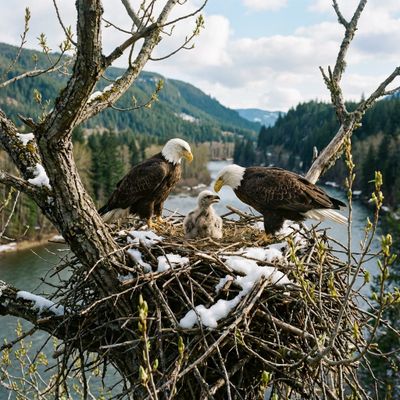
The Red‑winged Blackbirds were the unseen guidance — the chorus beneath the surface, the voice you hear before you see the evidence. The adult eagles were sovereignty watching from above, holding the higher perspective I couldn’t yet access. Their synchronized flight was alignment made visible — the ease of what is meant, the movement that doesn’t require force. And then came the eaglet, weeks ahead of season, standing in the nest as if to say: “Here is the revelation you’ve been waiting for.”
When you place the two weekends side by side, the sequence becomes clear:
Discernment → Guidance → Alignment → Revelation
The ravens prepared me.
The blackbirds confirmed me.
The eagles aligned me.
The eaglet revealed the truth.
These weren’t isolated encounters.
They were steps in a single unfolding.
The ravens were saying:
“A truth is coming.
Don’t decide yet.
Wait for the sign.”
And the sign arrived — not in words, not in logic, but in the form of a small, downy eaglet standing in a nest weeks ahead of schedule, declaring with its very existence:
“What is meant for you is already forming.”
The Soul Lesson — Trust & Faith
This is not a story about courage.
This is not a story about endurance.
This is not a story about hope.
This is a story about faith.
Faith in the unseen.
Faith in the timing.
Faith in the guidance.
Faith in the God who speaks through wings and wind and winter light.
Faith in the truth that rises when you stop forcing clarity and start listening.
The ravens didn’t give me an answer.
They gave me discernment.
The golden eagle didn’t give me direction.
He gave me truth.
The eaglet didn’t give me a plan.
He gave me revelation.
Together, they formed the message:
Trust the threshold.
Trust the guidance.
Trust the emergence.
Trust the God who is preparing what you cannot yet see.
What is meant for you is already alive.
Already forming.
Already growing.
Already here.
This is the soul lesson:
Trust & Faith.
Soul Lessons From God: Trust & Faith The First Eaglet
When the Unseen Becomes Visible
The Day That Called Me Forward
Some days arrive quietly, slipping into your life without asking anything of you. Others rise with a subtle pull — a nudge, a whisper, a sense that you need to be somewhere without knowing why. And then there are the days that call you with a clarity you can feel in your chest. Days when the world rearranges itself around you, guiding your steps before you even understand where you’re going.
Today was one of those days.
I didn’t plan to go to Star K Ranch. I didn’t have a reason. I only had a feeling — a persistent, gentle insistence that I needed to be there, and that I needed to go now, not tomorrow, not next week. So I listened. I went. And I’m grateful I did, because what unfolded was not just beautiful. It was orchestrated.
It was a message.
A message about trust.
A message about faith.
A message about what God reveals when you’re finally ready to see.
The Parents — Bald Eagles Sovereignty at the Threshold
When I arrived, the first thing I saw were the adult bald eagles perched beside their nest. They sat high in the trees, steady and composed, their bodies outlined against the warm winter sky. They weren’t restless. They weren’t hunting. They weren’t calling out. They were simply there — present, grounded, sovereign.
There is something unmistakable about the presence of adult eagles. They carry a gravity that doesn’t need to announce itself. They don’t perform. They don’t posture. They simply exist in their authority, and the world rearranges itself around them.
Seeing them both together felt significant. A bonded pair. A partnership. A unity. They were guardians of the moment, sentinels at the threshold of something I didn’t yet understand. I watched them for a while, letting their stillness settle into me, letting their presence soften the noise I had been carrying all week.
I didn’t know then that this was only the beginning.
The Hidden Choir — The Red‑Winged Blackbirds
As I continued down the trail, I heard them — a sound so loud, so layered, so alive that it stopped me in my tracks. Hundreds of Red‑winged Blackbirds, calling in a chorus that rose like a living wave. Their voices filled the air, echoing across the wetlands with a force that felt ancient.
But I couldn’t see a single one.
They were hidden deep in the cattails, tucked into the reeds, invisible to the eye but unmistakable to the ear. Their presence was undeniable, even though their bodies were nowhere to be found.
It was surreal — to hear so many and see none.
It was like listening to the heartbeat of the land itself.
And immediately, I felt the symbolism settle in:
Sometimes the guidance is loud long before it becomes visible.
Sometimes the truth surrounds you before it reveals itself.
Sometimes God speaks through what you can hear but cannot yet see.
Yesterday, I had seen one Red‑winged Blackbird — just one — perched in perfect light, singing his high melody, offering himself to my camera as if to say, Pay attention. I matter. Today, the unseen choir confirmed it.
The blackbirds were the first message:
Faith begins in the unseen.
Soul Lessons From God: Bald Eagles & Red-Winged Blackbirds
The Synchronized Flight — Bald Eagles Divine Alignment
As I rounded the bend, the air shifted. A shadow passed over me, then another. I looked up just in time to see the two adult eagles lift from their perch and fly directly above me — together, in perfect sync.
Their wings moved with effortless unity, each adjusting to the other with a grace that felt choreographed. They weren’t just flying. They were aligned. Their bodies cut through the air like a single thought, a single intention, a single movement.
It was breathtaking.
And it was symbolic.
Alignment is not forced.
Alignment is not strained.
Alignment is the natural result of trust.
Watching them, I felt something inside me loosen — the tightness of the week, the heaviness of uncertainty, the ache of disappointment. Their flight reminded me that when something is meant, it moves with ease. When something is true, it doesn’t require struggle. When something is aligned, it reveals itself in motion.
I didn’t know yet what they were leading me toward.
But I followed.
The Revelation — The First Eaglet of the Season
When I turned the corner, the blackbirds had gone silent. The air felt different — still, expectant, almost reverent. I glanced toward the nest, expecting to see nothing until the adults return.
Instead, I saw movement inside the nest.
At first, I thought it was a trick of the light. It’s February — far too early for eaglets. Incubation usually begins in February into early March. The earliest hatchings happen in late March, to early April. But this movement was unmistakable.
A small head.
Downy feathers.
A body shifting against the nest bowl.
An eaglet.
Who stood up in the nest – holding its head up high
I froze.
My breath caught.
My heart knew before my mind did.
This was not normal.
This was not expected.
This was not on schedule.
This was early emergence — life arriving ahead of time, ahead of season, ahead of what the world says is possible.
And in that moment, the message was undeniable:
What is meant for you will not follow the usual timeline.
It will come early.
It will come unexpectedly.
It will come even in strange seasons.
It will come because God said it’s time.
The eaglet was the revelation — the visible truth that had been forming long before I knew to look.
The Meaning — Trusting What You Cannot Yet See
As I stood there, watching the tiny eaglet shift around in the nest, everything from the past week rearranged itself in my mind. The noise. The exhaustion. The uncertainty. The heaviness. The sense of being pushed out of one chapter and pulled toward another.
It all made sense.
The blackbirds had been the unseen guidance.
The parents had been the guardians of the threshold.
The synchronized flight had been the alignment.
And the eaglet — the eaglet was the truth finally revealed.
This wasn’t just a wildlife moment.
This was a spiritual moment.
A divine moment.
A moment of revelation.
A moment where God said:
“You don’t have to see the whole path to trust it.
You don’t have to understand the timing to believe in it.
You don’t have to feel ready to be chosen.”
The eaglet was not supposed to be there yet.
And yet — there it was.
Alive.
Growing.
Held.
Provided for.
Protected.
Not because the season was right.
But because the timing was divine.
Soul Lessons From God: Symbolism and The Lesson
The Symbolism — What Each Encounter Carried
Each encounter today held its own message, its own layer of truth, its own way of speaking into the places where I’ve been stretched thin. None of them stood alone. They were individual notes in a larger composition — a sequence of symbols that, when placed together, revealed the full meaning of the day. This was not random wildlife behavior. This was a spiritual conversation unfolding in real time.
The Red‑winged Blackbirds
They were the first voice — loud, insistent, impossible to ignore, yet completely hidden. Their chorus rose from the cattails like a pulse, a heartbeat beneath the surface of the world. I could hear them with absolute clarity, but I could not see a single one.
That is the essence of faith.
Guidance in the unseen.
The chorus beneath the surface.
Faith before sight.
The blackbirds reminded me that God often speaks long before He shows. The sound arrives before the form. The knowing arrives before the evidence. Yesterday, one blackbird revealed himself. Today, the unseen choir confirmed the message: trust what you hear before you see it.
The Adult Bald Eagles
The adults were the guardians of the threshold — sovereign, steady, unshaken. Their presence carried weight, the kind of weight that doesn’t need to move to be felt. They watched from above with the calm of beings who understand the larger picture.
Sovereignty.
Guardianship.
Divine oversight.
The assurance that destiny is already in motion.
They were the reminder that I am not navigating this alone. Something higher is holding the vantage point I cannot reach.
The Synchronized Flight
When the pair lifted from their perch and flew overhead in perfect unity, it was more than beauty — it was confirmation. Their wings moved as one, adjusting effortlessly to each other, gliding with a grace that felt choreographed by something greater.
Alignment.
Partnership.
Movement without resistance.
The ease of what is meant.
Their flight showed me that what is aligned does not strain. It simply moves.
The Eaglet
And then — the revelation. An eaglet standing in the nest in February, weeks ahead of any expected timeline. A life emerging before the world said it should.
Early emergence.
Unexpected beginnings.
Life arriving ahead of schedule.
The visible truth of what God has been preparing.
The eaglet was the moment the unseen became visible — the proof that what is meant for you will not wait for the “right” season. It will arrive when God says it’s time.
The Soul Lesson — Trust & Faith
When I step back and look at the day as a whole, the pattern is unmistakable. This wasn’t random. This wasn’t coincidence. This wasn’t luck.
This was orchestration.
This was revelation.
This was God speaking through wings and reeds and winter light, saying:
Trust what I’m showing you.
Trust what is emerging.
Trust what is arriving early.
Trust what is unfolding even when you cannot see it yet.
Trust the timing that doesn’t make sense to the world.
Trust the path that calls you forward.
This is not a story about endurance.
This is not a story about fortitude.
This is not a story about courage.
This is a story about faith.
Faith in the unseen.
Faith in the timing.
Faith in the emergence.
Faith in the God who reveals what has been growing long before you knew to look.
Today, the wild didn’t just speak.
It revealed.
And the revelation was simple, powerful, and unmistakably divine:
What is meant for you is already alive.
Already forming.
Already growing.
Already here.
This is the soul lesson:
Trust the unseen.
Trust the emergence.
Trust the God who shows you what has been waiting for you all along.
Soul Lessons from God: Trust & Faith Northern Harrier

When the World Rearranges Itself to Move You Forward
The Week That Pressed In
Some weeks arrive quietly, slipping into your life without disturbance. Others rise like a tide, slowly but steadily pulling you into deeper waters. And then there are the weeks that arrive like a hand on your back — firm, insistent, unmistakably divine. They don’t wait for your readiness. They don’t soften themselves to your comfort. They simply begin the work of moving you.
This was one of those weeks.
Everything felt amplified. The noise at home was relentless, the uncertainty about where to go next was heavy, and the disappointment of realizing one place wasn’t right left a hollow ache. The emotional exhaustion of holding too much was catching up to me. And then came the bite, the wind, the unhinged man, and the raptors — each moment sharp, charged, and strangely connected.
At first, it felt like chaos. But God rarely speaks in straight lines. God speaks in patterns — through pressure, through symbols, through the things that rise when you’re too tired to pretend you don’t see them. And the pattern of this week was unmistakable.
This was a week about trust.
A week about faith.
A week about being moved — not gently, but unmistakably — toward the next chapter.
The Harriers — The Feminine and the Emerging Self
It began in the fields, in the wide‑open quiet of Wattenburg. I had gone there to breathe, to think, to escape the noise and heaviness pressing in from every direction. I didn’t expect anything unusual. I certainly didn’t expect clarity. But clarity rarely arrives when you’re looking for it. It arrives when you’re honest enough to admit you’re lost.
A female Northern Harrier flew low across the field, close enough that I could see the softness of her round owl-like face and the sharpness of her focus. She wasn’t passing through. She was presenting herself. And then the juvenile joined her — circling, diving, mirroring her movements with earnest, unsteady confidence.
For weeks, I had misread what I was seeing. I thought I was watching two females. But on this day, something clicked. This was not a pair of equals. This was a guide and a becoming — the mature feminine and the emerging self, flying together in the same sky.
Harriers are intuitive hunters. They fly low to the ground, reading the land with a sensitivity other raptors don’t possess. They represent emotional truth, instinct, and the kind of knowing that comes from the body rather than the mind. The female was the part of me that already knows. The juvenile was the part of me that is learning to trust that knowing.
They flew together because something in me was finally aligning. The part of me that has survived everything and the part of me that is stepping into something new were no longer in conflict. They were circling the same field, reading the same wind, moving in the same direction.
This is why clarity broke through the next day.
This is why the old option fell away.
This is why the new direction felt like truth.
The harriers were the first message: trust what rises, trust what calls, trust the direction that feels like home.
Soul Lessons from God: The Bald Eagles
The Eagles — Sovereignty Watching From Above
Not far from the harriers, two eagles sat in a tree — silent, steady, unbothered by the activity around them. They were new to the area, but they carried themselves like they had always belonged there. They weren’t hunting. They weren’t calling. They were simply watching.
Eagles are the messengers of sovereignty. They represent destiny, long‑range vision, and divine orchestration. They don’t waste energy. They don’t react to noise. They see from above, from a perspective that makes everything else look small.
Their presence felt intentional. They were the overseers of the moment, the guardians of the threshold. They weren’t there to guide me emotionally — that was the harriers’ role. They were there to confirm something larger: that the next chapter was already chosen, already unfolding, already waiting for me to step into it.
Their stillness carried a message of its own — a reminder that sometimes the most powerful thing you can do is stop trying to force clarity and simply allow God to reveal what is already in motion. Trust is not passive. Trust is surrender to the larger movement of life.
The Bite — The Boundary God Wouldn’t Let Me Ignore
Then came the bite.
It wasn’t punishment. It wasn’t failure. It wasn’t a lesson in compassion. It was a boundary — sharp, sudden, and impossible to ignore.
I had allowed too many people into the room. I had been holding too much energy, absorbing too much noise, trying to keep the peace at the expense of my own safety. And God used the bite to say, with absolute clarity:
You cannot keep sacrificing yourself.
You cannot keep absorbing what isn’t yours.
You cannot keep holding the room for everyone else.
It wasn’t about the cat.
It was about the pattern.
The bite was the moment the pattern broke open. It was the moment God said, “Enough.” It hurt. It shook me. It forced me to confront the truth I had been avoiding: that protecting myself is not selfish — it is sacred.
Trust your limits.
Trust your instincts.
Trust that protecting yourself is holy.
The Human Layer — Confusion, Disappointment, and the Test of Trust
Before the red‑tail appeared, there was the human layer — the part of the week that pressed on old wounds and exposed the cracks in places I once hoped would be solid.
Working with raptors has always been a place of meaning for me, a place where I expected clarity, mentorship, and steadiness. But lately, it has been tangled. One person I once thought could be a true guide revealed himself to be something else entirely — inconsistent, confusing, more invested in his own image than in teaching. And the mentor standing in front of me now carries her own contradictions, her own sharp edges, her own unpredictability.
It’s hard to find footing in that. Hard to know who to trust. Hard to know where I stand. And yet — I showed up anyway.
I stood in the wind.
I did the work.
I held my ground.
I stayed present even when the dynamic felt unstable, even when the disappointment from the past and the confusion in the present pressed against each other.
It wasn’t just the weather that was testing me. It was the dysfunction, the uncertainty, the worry about what I’m stepping into, the fear that the place I hoped would be solid might not be.
And still — I made it through the day.
I didn’t collapse.
I didn’t retreat.
I didn’t lose myself.
I stayed aligned with the part of me that knows why I’m there — the part that listens to God, not to human inconsistency.
And only after that — after the emotional pressure, the spiritual test, the human confusion — did the red‑tail appear.
Because the red‑tail wasn’t just about endurance.
It was about confirmation.
Soul Lessons from God: The Red-Tailed Hawk
The Red‑Tail — Perseverance in Impossible Wind
The wind was brutal — wind gusts upwards of fifty miles per hour — cold, bitter, relentless, unyielding. It was the kind of wind that makes even the strongest birds retreat to shelter. But not this one.
A red‑tailed hawk was kiting in the storm, holding its position with fierce determination, diving when the moment was right, refusing to be pushed off course. It wasn’t waiting for better conditions. It wasn’t conserving energy. It was doing what it came to do, no matter the wind.
Red‑tails are the raptors of grit, survival, and endurance. They represent the part of the soul that refuses to give up, even when everything around you is working against you.
Watching that hawk was like watching a mirror of my own week — the pressure, the noise, the confusion, the exhaustion — and the quiet, stubborn truth beneath it all:
I am built for this.
I can withstand the wind.
I can move through pressure.
I can trust the strength God put in me.
And when two more red‑tails appeared — circling with him — the message deepened: you are not alone in this. Your lineage of strength is behind you.
The Angry Man Who Lost His Way — The Human Mirror
And then came the man at the store — explosive, reactive, projecting, collapsing into victimhood. The kind of moment you see in viral videos, except this time it was happening to me.
He wasn’t the lesson.
He was the confirmation.
He showed me how small people can be, how quickly they crumble, how easily they reveal their own wounds, how little their reactions have to do with me. And I didn’t absorb it. I didn’t shrink. I didn’t internalize it.
I laughed.
Not out of cruelty — but out of clarity. Because in that moment, I understood: not every storm is mine. Not every projection belongs to me. Not every wounded person is my responsibility.
Trust your discernment.
Trust your strength.
Trust that not every storm is yours to weather.
The Soul Lesson — Trust What God Is Moving
When I step back, the pattern is undeniable:
The harriers showed inner knowing.
The eagles showed destiny watching.
The bite showed boundaries.
The human dynamics showed discernment.
The red‑tail showed perseverance.
The clarity that rose the next day showed direction.
This was not a week of chaos.
This was a week of orchestration.
A week where God said:
Trust what I’m showing you.
Trust what I’m moving you toward.
Trust what I’m removing.
Trust what I’m revealing.
Trust what I’m strengthening in you.
This is not a story about courage.
This is not a story about endurance.
This is a story about faith.
Faith in the signs.
Faith in the movement.
Faith in the redirection.
Faith in the next chapter rising.
Faith in the God who speaks through wind and wings and pressure.
This is the soul lesson:
Trust the path even when everything is shaking.
Trust the guidance even when it arrives through discomfort.
Trust the shift even when it disrupts what you thought you wanted.
Trust the God who is moving you — because He is not wrong about you.
Soul Lessons from God: The Grace of Trust and Faith
The Grace of Trust and Faith: Overcoming Fear and Embracing Spiritual Growth
Trust and faith are not merely virtues; they are profound graces that form the backbone of spiritual growth. Each offers a unique, yet complementary, way to navigate life’s uncertainties and embrace its possibilities.
Trust is the act of believing—believing in ourselves, in our choices, and in the Divine guidance that steers us forward. It grounds us in the present moment, urging us to release the grip of fear and allow clarity to arise from within.
Faith, on the other hand, is the surrender to the unknown, a deep-rooted assurance that life’s unfolding is purposeful and guided by a higher wisdom. Together, these graces create a powerful framework for self-discovery, inner peace, and the resilience to face life’s challenges.
At their core, trust and faith are tools for overcoming fear. Fear often clouds our minds, disguising itself as doubt, hesitation, or the need to control outcomes. Trust cuts through this fog, reminding us of past victories and the strength we carry within.
It encourages us to act on our intuition, even when the path ahead is uncertain. Faith takes this one step further—it asks us to relinquish the need for guarantees, embracing life’s mysteries with confidence in the Divine plan.
By cultivating both trust and faith, we step into a flow of grace that silences fear, strengthens our resolve, and opens the door to transformation.
While these graces may seem elusive, they are not beyond reach. They can be nurtured through intentional practices—such as prayer, meditation, and self-reflection—that help us attune to the wisdom of the soul and the presence of the Divine.
With time and practice, trust and faith become more than concepts; they become lived experiences that empower us to navigate even the most challenging moments with courage and grace. They guide us to look inward for answers, align our actions with higher truths, and find peace in the balance of life’s polarities.
Together, they illuminate the spiritual path, reminding us that we are never alone and that every step forward carries the potential for growth and healing.
The Grace of Trust: Releasing Fear and Building Inner Strength
Trust is the foundation of inner stability, the ability to believe in ourselves, our choices, and the guidance of the Divine even when uncertainty surrounds us.
It asks us to let go of the fear that whispers, we are not enough or that the path ahead is insurmountable. Trust is the grace that helps silence these inner demons, those persistent doubts and fears—and reminds us that we have the strength to overcome anything.
This grace encourages us to draw on positive inner messages and memories, reminding us of the times we trusted our instincts and made powerful choices. Trust allows us to revisit those experiences, grounding ourselves in the knowledge that we have faced challenges before and can do so again.
One of the hardest aspects of trust is overcoming the influence of others’ fears. Sometimes, the anxieties of those around us seep into our own consciousness, disguised as logical advice or ordinary conversation.
Trust acts as a protective shield, allowing us to recognize these fears for what they are and detach from their influence. Prayer, meditation, or mindfulness creates a field of grace around us, helping us identify and release the illusion of fear.
Through trust, we find clarity in the face of uncertainty and learn to stand firm in our own truth, empowering us to make choices guided by intuition rather than hesitation.
The Grace of Faith: Embracing the Unknown and Building Self-Belief
Faith is the companion to trust, urging us to surrender to the unknown with confidence in the Divine plan and the unfolding of our own potential. This grace helps us rise above the need for control, teaching us to trust not only in higher guidance but also in ourselves. Faith invites us to see setbacks not as failures but as steppingstones, to recognize struggles as opportunities for growth.
Cultivating faith begins with small but powerful acts of self-trust. For example, keeping a promise to yourself, whether committing to meditating each morning or completing a meaningful project—builds the foundation for greater confidence. These seemingly simple acts remind us that we are capable, reliable, and deserving of our own belief.
Faith also empowers us to overcome survival fears, those primal doubts that convince us we must cling to the familiar to remain safe. By stepping into faith, we release these fears and open ourselves to transformation. Consider the leap of starting a new business or pursuing a dream—faith gives us the courage to trust in our ability to adapt, learn, and thrive even in uncharted territory.
This grace also deepens our connection to intuition. Having confidence in ourselves enables us to trust our inner guidance, allowing it to direct us towards aligning with our true purpose. Over time, faith strengthens both our relationship with ourselves and with the Divine, becoming a beacon of light that guides us forward.
Overcoming the Challenges of Trust and Faith
The path to cultivating trust and faith is not without its difficulties. Doubts, fears, and societal conditioning often stand as barriers to these graces, making it challenging to release the need for control or to embrace the uncertainty that life presents.
Trust and faith require us to break free from deeply ingrained patterns of hesitation and resistance, a process that can feel daunting but ultimately leads to profound transformation.
Fear is often the first and most persistent obstacle in developing trust and faith. It disguises itself as caution or logic, weaving into our inner dialogue and convincing us to avoid risks or change. Recognizing fear for what it is—a temporary and manageable state—is the first step to overcoming it.
Through practices like prayer, meditation, or quiet reflection, we can create space to examine our fears and loosen their hold over us. These moments of stillness build a protective field of grace around us, allowing us to reconnect with our inner truth and recognize the strength we hold.
Surrounding ourselves with symbols of trust—such as affirmations, meaningful memories, or tangible reminders of past successes—further reinforces our resilience and helps us silence doubts.
Faith, closely tied to trust, invites us to go deeper by surrendering to the unknown. For many, this surrender feels counterintuitive, how can we release control when uncertainty feels overwhelming. The key lies in small but consistent acts of self-belief.
Setting achievable goals, such as committing to a daily meditation practice or following through on a personal promise, establishes the foundation for faith. Each time we honor our word; we affirm our ability to rely on ourselves and the wisdom of our inner guidance. Over time, these small victories accumulate, gradually expanding our capacity to face larger challenges with courage and trust.
The challenges of trust and faith are further compounded by external influences—the fears and doubts of others that often infiltrate our own thoughts. These external fears can disguise themselves as well-meaning advice or cautionary tales, clouding our judgment.
Protecting ourselves from such influences requires clarity and intention. By recognizing these fears as separate from our own, we can detach from their effects and remain anchored in our truth.
Developing trust and faith is a lifelong process, one that asks for patience and dedication. Although obstacles may persist, the rewards are undeniable. These graces empower us to navigate life with confidence, courage, and serenity.
They remind us that even in the face of uncertainty, we carry the tools to overcome challenges and embrace the unknown with open hearts. Trust and faith illuminate the spiritual journey, guiding us toward healing and transformation.
The Grace of Trust and Faith: A Lifelong Journey
Trust and faith are profound and transformative graces that serve as the foundation for spiritual growth and self-discovery. These twin virtues empower us to release fear, navigate life’s uncertainties, and embrace the fullness of our spiritual journey.
They are not simply passive states of belief but active practices that deepen our connection to the Divine and strengthen our alignment with our true selves. Together, trust and faith guide us toward integrity, purpose, and inner peace, enabling us to live more fully and authentically.
The grace of trust invites us to believe in our ability to overcome challenges and to find steadiness in life’s ebb and flow. It grounds us in the knowledge that, even when circumstances seem uncertain, we are capable of navigating them with clarity and resilience.
Trust allows us to silence the voice of doubt, affirming that we have the inner strength and wisdom to handle what comes our way. This grace helps us look inward and listen to the quiet yet powerful guidance of our intuition, reminding us that we are stronger and more capable than we often realize.
Faith complements trust by urging us to surrender to the unknown, placing confidence in the Divine plan and the unfolding of our personal path. It is the assurance that even when we cannot see the full picture, every step forward has meaning and purpose.
Faith asks us to let go of the need for control, choosing instead to embrace life’s mysteries with courage and openness. In doing so, we align ourselves with the flow of Divine wisdom, trusting that every twist and turn serves a higher good.
These graces work together to transform how we approach life’s challenges. They do not promise to eliminate obstacles, but they do empower us to meet them with strength and grace.
Trust grounds us in self-belief, while faith inspires us to move forward even when the path is unclear. Both remind us that we are never alone, as we are always supported by the light of the Divine and the connections we share with others.
Cultivating trust and faith is a lifelong process, one that requires patience, dedication, and intentional practice. Prayer, meditation, and reflection help us nurture these graces, allowing them to become central to our lives.
As we develop trust and faith, we open ourselves to transformation—not through the absence of difficulty but through the clarity, confidence, and grace with which we approach it. Each step we take, no matter how small, leads us closer to light, unity, and a deeper understanding of our place within the greater tapestry of existence.

Soul Lessons with God: Trust & Faith and the Red Tail Rising
A Lesson in Trust, Faith, Courage, Endurance, and the Quiet Return of Hope
There are moments in nature that do not simply unfold — they align. Moments where the landscape feels orchestrated, where the wind, the sky, and the creatures moving through it seem to be speaking the same language. These are not coincidences. They are not random. They are not accidents of timing. They are the moments when God uses creation to speak directly to the soul, not through words, but through harmony. Through timing. Through presence. Through the quiet choreography of the wild.
This is the story of a juvenile red‑tailed hawk learning to ride the thermals. A story of meadowlarks singing in chorus. A story of eagles nesting nearby, steady and unbothered. A story of a landscape alive with meaning. And a story of how, in the middle of one of the hardest months I’ve had in a long time, God offered a lesson in trust, faith, endurance, courage, and the quiet return of hope.
This is not a story of struggle.
It is a story of rising.
The Landscape of a Hard Month
The last month has been filled with noise — emotional noise, physical noise, spiritual noise. Disruption. Intrusion. Exhaustion. The kind of chaos that makes it hard to hear yourself, let alone God. The kind of overwhelm that dulls intuition, blurs clarity, and makes even simple moments feel heavy. I had been stretched thin, pulled in too many directions, and trying to hold onto trust and faith even when everything felt uncertain.
And yet, in the middle of all of that, I kept returning to the land. To the nests. To the places where I feel most connected to something larger than myself. The places where God speaks through feathers and wind and instinct and song. The places where the wild becomes a sanctuary.
It was at one of those nests — the same one where I had seen the bluebirds and heard the meadowlark but could not find it — that this moment unfolded. A moment that felt like a message. A moment that felt like alignment. A moment that felt like God saying, “I know it has been hard. But look. Look at what is rising.”
The Juvenile Red‑Tail: The One Learning to Rise
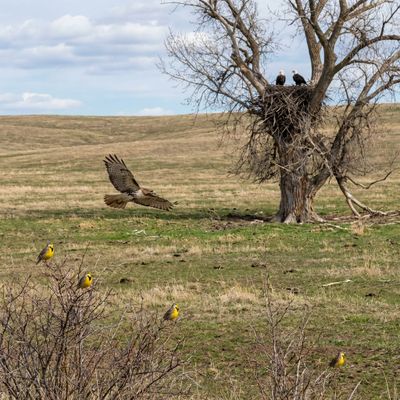
He appeared suddenly — a young red‑tailed hawk circling above the cottonwoods, wings wide, tail catching the light. He was unmistakably juvenile, still learning the rhythm of the air, still figuring out how to ride the thermals with confidence. His flight was not yet the smooth, effortless glide of an adult. It was exploratory. Curious. Experimental. He was practicing. Testing. Learning.
He was rising without mastery.
He was rising without certainty.
He was rising without perfection.
He was rising because that is what he was born to do.
There was something deeply moving about watching him. He wasn’t afraid of the air. He wasn’t afraid of the height. He wasn’t afraid of the wobble in his wings. He simply kept circling, kept adjusting, kept trusting the invisible currents beneath him.
He was learning to be king of the sky.
And in watching him, I felt something inside me shift — a recognition that I, too, was in a season of learning to rise again. Not perfectly. Not gracefully. Not effortlessly. But faithfully.
The juvenile red‑tail was a mirror of becoming.
The Meadowlarks & The Bald Eagle Family
The Harmony of the Meadowlarks & The Bald Eagles
The Meadowlarks: The Voices of Clarity
The last time I visited this nest, I could hear the meadowlarks but could not find them. Their song was everywhere, but their bodies were nowhere. It felt symbolic at the time — guidance I could sense but not see, clarity I could hear but not locate, intuition that was present but not fully accessible.
But this time was different.
Every time a meadowlark began to sing, I could find it. Instantly. Effortlessly. As if the land itself had shifted to make them visible. They perched on fence posts, on branches, on tall grasses, their yellow chests glowing in the sun, their songs ringing out like declarations of joy.
It felt like a message: “What you could only hear before, you can now see.”
Clarity was returning.
Discernment was returning.
My inner senses were coming back online.
The meadowlarks were not just singing.
They were affirming.
Their voices felt like God’s reassurance — a reminder that even when the path feels obscured, clarity always returns. And when it does, it arrives with song.
The Eagles: The Anchors of the Sky
Nearby, the eagles were nesting — steady, grounded, unbothered by the juvenile red‑tail’s presence. They watched the landscape with the calm authority of beings who know their place in the world. Their nest was quiet, but not empty. I suspected the eaglet had been born, though still too small to see. The adult’s posture — upright, alert, attentive, continually looking down — this was the posture of a parent tending new life.
The eagles were not the focus of the moment, but they were the foundation of it. Their presence anchored the landscape. Their steadiness held the space. Their nest represented continuity, lineage, and the quiet unfolding of something new.
They were the reminder that even when you cannot see the beginning, it is still happening.
Something was being born — in their nest, and in my life.
The Harmony of the Moment
A juvenile hawk rising.
Meadowlarks singing.
Eagles nesting.
Three species, three messages, one moment.
The hawk represented becoming.
The meadowlarks represented clarity.
The eagles represented stability.
Together, they formed a spiritual chord — a harmony of meaning that felt unmistakably divine. Nothing was competing. Nothing was out of place. Everything was aligned.
It felt orchestrated.
It felt intentional.
It felt like God.
This was not nature being beautiful.
This was nature being prophetic.
The Soul Lesson in Trust & Faith
The God Who Speaks Through the Sky
The Soul Lesson: Trust & Faith
The juvenile red‑tail taught me about trust — the kind of trust that rises even when the air is uncertain. The kind of trust that spreads its wings even when the body is still learning. The kind of trust that says, “I don’t know how to do this yet, but I will.”
The meadowlarks taught me about faith — the kind of faith that sings even when the world has been chaotic. The kind of faith that becomes visible again after a season of obscurity. The kind of faith that says, “Clarity always returns.”
The eagles taught me about endurance — the kind of endurance that sits on a nest through storms, through wind, through uncertainty, through the long waiting for new life to emerge. The kind of endurance that says, “Something is being born, even if you cannot see it yet.”
And the entire moment taught me about hope — the quiet, steady hope that rises when everything aligns, when the landscape speaks, when the soul recognizes the voice of God in the wind.
This was a lesson in trust.
A lesson in faith.
A lesson in courage.
A lesson in endurance.
A lesson in hope.
Closing Reflection: The God Who Speaks Through the Sky
As I stood there, watching the juvenile red‑tail circle above me, listening to the meadowlarks sing, feeling the presence of the nesting eagles nearby, I felt something I had not felt in weeks — peace. Not the fragile peace that comes from things being quiet, but the deep peace that comes from knowing you are held, guided, and seen.
God was not silent.
God was not distant.
God was not absent.
God was speaking through the sky.
Through the hawk learning to rise.
Through the meadowlarks singing with joy.
Through the eagles tending new life.
Through the harmony of the moment.
Through the alignment of the landscape.
Through the timing that could not be coincidence.
And perhaps that is the real lesson:
Trust the rising.
Trust the clarity.
Trust the stability.
Trust the new beginning you cannot yet see.
Trust the God who orchestrates the sky.
The story continues.
And I will meet God where He speaks — every time.
Soul Lessons with God: Trust & Faith Return to the Beginning
When God Brings You Back to the Place Where Your Life Split in Two
There are moments in life when God does not move me forward, but instead turns me gently around and walks me back to the place where everything began. Not to punish me. Not to reopen wounds. Not to drag me into the past. But to show me something I could not have seen then, something I can only understand now, something that requires the eyes of the woman I have become rather than the girl I once was.
These moments do not arrive with thunder or spectacle. They arrive quietly, disguised as errands, as new clients, as unexpected routes, as familiar streets I have not driven in years. They arrive as a return — not to the past, but to the origin point of a chapter that is finally ready to close.
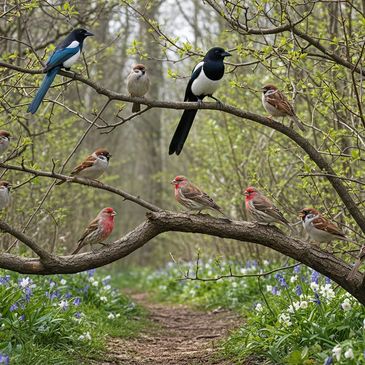
This is the story of being brought back to the first neighborhood I lived in when I fled Reno after my mother died. A story of rabbits and magpies and sparrows and finches — the same species that surrounded me then, appearing again now as if summoned by memory itself.
A story of a boy I once dated, now gone from this world, marking the end of an era I didn’t realize was still open. A story of the cats who carried me through the years that followed — the lifeline that bridged the girl I was with the woman I would one day become.
A story of a trail I could not have walked twenty years ago, but can walk now with ease, with grounding, with presence, with God. And a story of how, in the middle of a month filled with uncertainty, exhaustion, and waiting, God used the land, the animals, and the return to my beginning to teach me the grace of trust and faith.
The Girl Who Fled Reno: The True Beginning of the Story
When my mother died in 2005, the world I knew collapsed in a single breath. I was newly clean, still fragile, still learning how to live without the scaffolding of addiction, still learning how to feel without numbing, still learning how to exist in a body that had never known safety.
I was young, unformed, unsteady, and grieving the only person who had ever been my anchor. Reno became unbearable — every street, every memory, every corner of that city held the echo of her absence. I could not breathe there anymore. I could not stay. I could not survive.
So I ran. I took a job I knew I wouldn’t keep because it offered a free trip to Denver — the place my mother and I had once dreamed of moving to together. I packed my life and headed east, not because I was ready to start a new life, but because I could not remain in the old one.
I arrived in Denver not as a woman beginning a chapter, but as a girl fleeing the ruins of one. I was lost, grieving, overwhelmed, and trying to figure out how to live without the person who had always been my compass.
I did not move to Denver with hope.
I moved here with desperation.
And that matters, because the woman I am now is not fleeing anything.
She is walking out with clarity.
The First Denver Apartment: The Birthplace of My Survival Self
My first apartment in Denver was not a home. It was a shelter. A place where I hid from the grief that threatened to swallow me whole. A place where I tried to figure out how to be alive without my mother. A place where I was still learning how to be clean, how to be sober, how to be human.
A place where I dated a boy who was just as lost and broken as I was — two young people trying to hold onto each other while drowning in their own unhealed wounds. A place where I was disconnected from nature, from God, from my own body, from my own intuition.
It was the birthplace of my survival self — the version of me who did not yet know how to live, but was trying anyway. The version of me who was still raw, still fragile, still forming. The version of me who was trying to build a life without any tools, any guidance, any sense of direction. The version of me who was simply trying to make it through each day.
And now, twenty‑one years later, I am being brought back to that exact neighborhood. Not to relive it. Not to reopen it. But to release it.
The Animal Friends That Never Left My Side
The Animals Who Were With Me Then — and Now
When I first moved to Denver, I didn’t take many photos. I didn’t yet know how to see the world the way I do now. But the few photos I did take were of rabbits — soft, quiet, gentle creatures that appeared around my apartment complex.
I didn’t know then what they meant. I didn’t know then that rabbits symbolize new beginnings, innocence, vulnerability, and rebirth. I didn’t know then that they were the first animals to greet me in my new life. I didn’t know then that they were marking the start of a chapter that would take twenty‑one years to complete.
And now, as I return to that neighborhood, the rabbits are everywhere — adults, babies, entire families grazing in the grass along the High Line Canal. They appear as if summoned by memory, as if they have been waiting for me to return.
They are the bookends of my Denver story — the first animals I saw when I arrived, and the ones appearing now as I prepare to leave. They are the symbol of the new beginning I was too broken to recognize then, and the new beginning I am finally ready to step into now.
The magpies were with me in Reno when my mother was alive. They were the birds of my landscape in my 20’s — intelligent, vocal, watchful, always present. They were the bridge between me and my mother, between memory and the present moment.
And now, as I walk the trail near my old apartment, the magpies appear again — calling, swooping, watching from the branches. They are the reminder that my mother’s presence has never left me. They are the reminder that memory is not a place I return to, but a thread that follows me. They are the reminder that I am not walking this return alone.
The house finches and sparrows were part of my Reno life too — the small, everyday birds that filled the patio of both my apartment and my mothers. They represent survival, resilience, the quiet continuation of life even in the midst of chaos.
They were with me when my mother was alive. They were with me when I fled Reno. And they are with me now, singing from the bushes along the trail, reminding me that even in the hardest seasons, life continues. Even in the darkest moments, something endures.
These animals are not random.
They are not incidental.
They are not background.
They are the witnesses of my story — then and now.
The Boy Who Died: The Death of an Era
The boy I dated during those early Denver years died a few weeks ago. He was five years younger than me. He was part of the era I fled into after my mother died. He was part of the version of me who was lost, grieving, unformed. His death is not about romance. It is not about unresolved feelings. It is not about what could have been.
His death is symbolic.
It marks the end of the era he belonged to.
It marks the end of the girl I was when I knew him.
He was one of the last living witnesses to the version of me who arrived in Denver broken and terrified. And now he is gone. His passing is the closing of a timeline I didn’t realize was still open. It is the final thread of a chapter that is ready to be released.
And yes, I am grieving him, but I am also grieving the version of me who existed when he was in my life.
And that is the closure God is offering me now.
The Era of Cats: The Ones Who Saved Me
The Era of Cats: The Lifeline That Carried Me Through
But the return to this neighborhood is not only tied to the girl I once was or the boy who belonged to that era. It is also tied to the chapter that came after him — the chapter that saved me, shaped me, and carried me through the next twelve years of my life.
Because after that relationship ended, I was pulled — unmistakably, undeniably — toward cats. Toward rescue. Toward the broken ones, the abandoned ones, the sick ones, the forgotten ones. Toward the creatures who needed someone who understood what it meant to survive what should have destroyed them.
I adopted Roxie first, and she opened a door I didn’t know existed. Within a year, I was deep in rescue — bottle babies, medical cases, hospice cats, ferals, seniors, the ones no one else wanted. I didn’t choose rescue. Rescue chose me.
And for the next twelve years, cats were my life. My identity. My purpose. My grounding. My family. My lifeline. I had more cats than anyone should have, but I made it work because they were the only thing that made sense in a world that still felt unsteady beneath my feet.
From 2006 to 2018, rescue was the center of my universe. It was the place where I learned compassion, patience, resilience, and the quiet art of showing up for beings who could not ask for help. It was the place where I learned how to nurture, how to advocate, how to fight for life. It was the place where I learned how to love again after losing my mother.
And even when I left rescue in 2018 — a decision that nearly broke me — I still had seven of my own cats to care for. Seven souls who had grown old with me, who had lived through every move, every heartbreak, every transformation. They lived to be eighteen and nineteen, each with their own medical challenges, each requiring more from me than I sometimes had to give, but I gave it anyway because they had given me everything.
And then, one by one, they left — and last year I lost the last two. Roxie in January 2025. Ophelia in June 2025 — almost exactly a year ago. The last of the original seven. The last thread of the era that had carried me through the darkest years of my life.
I had already begun fostering Remi and Emily before Ophelia passed, but even that chapter shifted. Emily found her home. Remi stayed — my boy, my shadow, my companion — but he cannot live with other cats. And so the era of a multi‑cat household, the era of rescue, the era of feline medicine, fostering, hospice and caretaking, the era that defined me for almost two decades… ended.
It ended quietly.
It ended naturally.
It ended without ceremony.
But it ended.
And now, as I walk through the neighborhood where my Denver life began, I can feel that chapter closing too — not with grief, but with gratitude. Cats were my lifeline when I had nothing else. They were the bridge between the girl who fled Reno and the woman who would one day walk into nature and hear God in the wind.
They carried me through the years when I could not carry myself. They taught me how to love, how to nurture, how to endure, how to stay alive.
But they were not the end of my story.
They were the middle.
And when I became sick in 2023 — three surgeries, over a year of recovery, a body that felt like it was failing — something shifted. I found nature. I found wildlife. I found the land. I found the sky. I found the animals who do not live in my home but live in the world, the ones who speak through instinct, presence and timing. I found a new language. A new calling. A new way of being alive.
And I have not looked back since.
Now, in 2026, I can see it clearly: the era of cats was the era that kept me alive long enough to find the era of nature. The era of rescue was the era that taught me how to care for others so I could one day learn how to care for myself. The era of feline medicine was the era that prepared me for the spiritual medicine of the wild.
That chapter is closed.
And this return — this walk through the neighborhood where everything began — is part of that closure too.
Nature and Wildlife: My True Calling
The High Line Canal: Walking a Trail I Could Not Have Walked Then
I found a nature spot near my old apartment — a stretch of the High Line Canal I never walked when I lived there. I couldn’t have walked it then. My nervous system wasn’t ready. My grief was too raw. My identity was too unformed. I didn’t yet know how to be in nature. I didn’t yet know how to be in my body. I didn’t yet know how to be alive.
But now, I walk that trail with ease. I walk it with grounding. I walk it with presence. I walk it with God. I walk it as the woman I have become — a woman who reads the land, who reads the sky, who reads the animals, who hears God in the wind, who knows her path, who trusts her instincts, who understands her own soul.
I am walking through the past with the body, mind, and spirit of the woman I am now — not the girl I once was.
This is the moment of trust.
This is the moment of faith.
This is the moment of closure.
The Soul Lesson: The Grace of Trust & Faith
The rabbits taught me about trust — the trust required to begin again, the trust required to step into a new chapter even when I feel vulnerable, the trust required to believe that new life is possible after loss.
The magpies taught me about faith — the faith that memory is not a place I return to, but a presence that walks with me, the faith that my mother’s love has never left me, the faith that I am guided even when I feel alone.
The finches and sparrows taught me about endurance — the endurance required to survive the hardest seasons, the endurance required to keep going when everything feels uncertain, the endurance required to build a life one small moment at a time.
The return to my old neighborhood taught me about trust — the trust required to believe that God brings me back only to release me, not to trap me.
His death taught me about closure — the closure of an era, the closure of a version of myself, the closure of a chapter that began in grief and is ending in consciousness.
And the trail taught me about faith — the faith required to walk into the future without carrying the past unconsciously.
This is the grace of trust.
This is the grace of faith.
This is the grace of a God who brings me full circle only when I am ready to leave the circle behind.
Closing Reflection: The God Who Brings Me Full Circle
As I walked the High Line Canal, surrounded by rabbits, magpies, sparrows and finches, I felt something I have not felt in a long time — peace. Not the fragile peace that comes from quiet, but the deep peace that comes from understanding. The peace that comes from seeing the arc of my own life. The peace that comes from recognizing the woman I have become. The peace that comes from knowing that God is not asking me to return to the past, but to release it.
I am not the girl who fled Reno.
I am not the girl who lived in that apartment.
I am not the girl who dated him.
I am not the girl who didn’t know how to live.
I am not the girl who couldn’t walk in nature.
I am the woman who reads the land.
I am the woman who hears God.
I am the woman who trusts the timing.
I am the woman who walks with faith.
I am the woman who knows her path.
I am the woman who is ready to leave Colorado consciously, not unconsciously.
This is the closure of a twenty‑one‑year chapter.
This is the release of the girl I once was.
This is the emergence of the woman I have become.
Trust the return.
Trust the closure.
Trust the timing.
Trust the God who brings me full circle.
The story continues.
And I will meet God where He speaks — every time.
Learn More About Soul Life Lessons

Soul Life Lessons Blog
Spirit Animal Symbolism
Soul Life Lessons Blog
Written Series
Spirit Animal Symbolism
Soul Life Lessons Blog
Spirit Animal Symbolism
Spirit Animal Symbolism
Spirit Animal Symbolism